
Support the Deskooled substack by upgrading your subscription.

Something strange has been happening to Flock Safety cameras across the country this summer, and it isn’t a technical glitch.
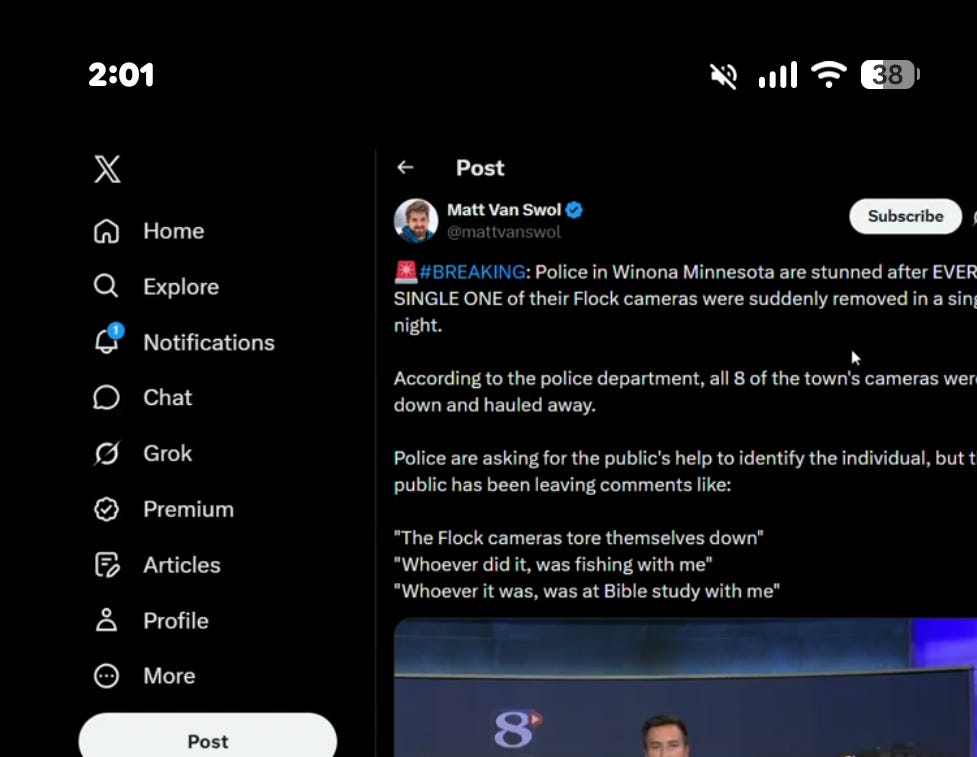
In Winona, Minnesota, all eight of the city’s automated license plate readers vanished between July 29 and August 1. Officers found the metal poles sawed off near the base and discarded in the weeds. The camera units themselves were gone, and as of this writing, none have been recovered. The estimated damage runs about $24,000.
Winona isn’t alone. Duluth, Columbia Heights, West St. Paul, North Branch, Faribault, Plymouth, Edina, Anoka County — cameras in all of these Minnesota communities have been vandalized, stolen, or formally removed by local decision in the last few months. In West Virginia, a 20-year-old named Wesley Jackson was arrested and charged with two felonies after deputies say they caught him on business security footage cutting down a Flock camera near Morgantown. When a local news station posted about his arrest, nearly 20,000 people flooded the comments with tongue-in-cheek alibis, insisting he’d been fixing a homeless shelter roof or serving soup at a kitchen at the exact time in question.
Whatever you think of the method, it’s worth sitting with why so many ordinary people are cheering it on.
Let’s be completely clear about one thing first: destroying government property is a felony, and it should be. Jackson and his co-defendant are each facing two felony charges and posted $15,000 bonds. That’s not a slap on the wrist, and nobody reading this should walk away thinking property destruction is a smart or safe way to make a political point. It isn’t. If you have a problem with Flock cameras in your town, the fight belongs at your city council meeting, not at the base of a pole with a set of bolt cutters.
But understanding why people feel pushed toward that pole matters too.
Flock Safety has installed more than 120,000 of these cameras nationwide, feeding license plates, vehicle descriptions, and location data into a searchable database available to thousands of law enforcement agencies. Supporters point to real results — solved homicides, recovered stolen vehicles, located missing people. Winona police themselves credited the cameras with helping locate a homicide suspect. Nobody serious is arguing these tools have never caught a criminal.
The trouble is what happens when the tool gets used for something other than catching criminals. Officers in multiple departments have been caught running searches for personal reasons that had nothing to do with an active case — checking up on an ex, tracking a family member. A Colorado woman was wrongly accused of package theft when an officer told her he was “100 percent” certain Flock footage proved it, only walking it back after she produced her own GPS data. That’s the nightmare version of this technology: a permanent, searchable record of where your car has been, built without a warrant, reviewed by whoever has the login.
And that’s where the unease starts to look a lot less like paranoia.
China’s social credit system didn’t arrive in one dramatic announcement. It built itself out of exactly this kind of infrastructure — cameras, databases, location tracking, all justified one reasonable-sounding public safety win at a time, until the pieces added up to a surveillance apparatus that could follow a citizen’s entire life. Nobody is claiming America is there. But the raw material — a nationwide, privately built, searchable log of where every scanned car has been — is the same raw material that system runs on. Is it really unreasonable for someone to look at 120,000 cameras with no warrant requirement and ask where the line actually is?
That’s the question Winona’s police department itself seemed to land on. After the theft, the city announced it would not be replacing the cameras. In its statement, the department acknowledged the tool had been useful, but said its use had “contributed to growing concerns about trust in policing.” That’s a police department, not a protest group, conceding that the technology cost more in public trust than it delivered in solved cases.
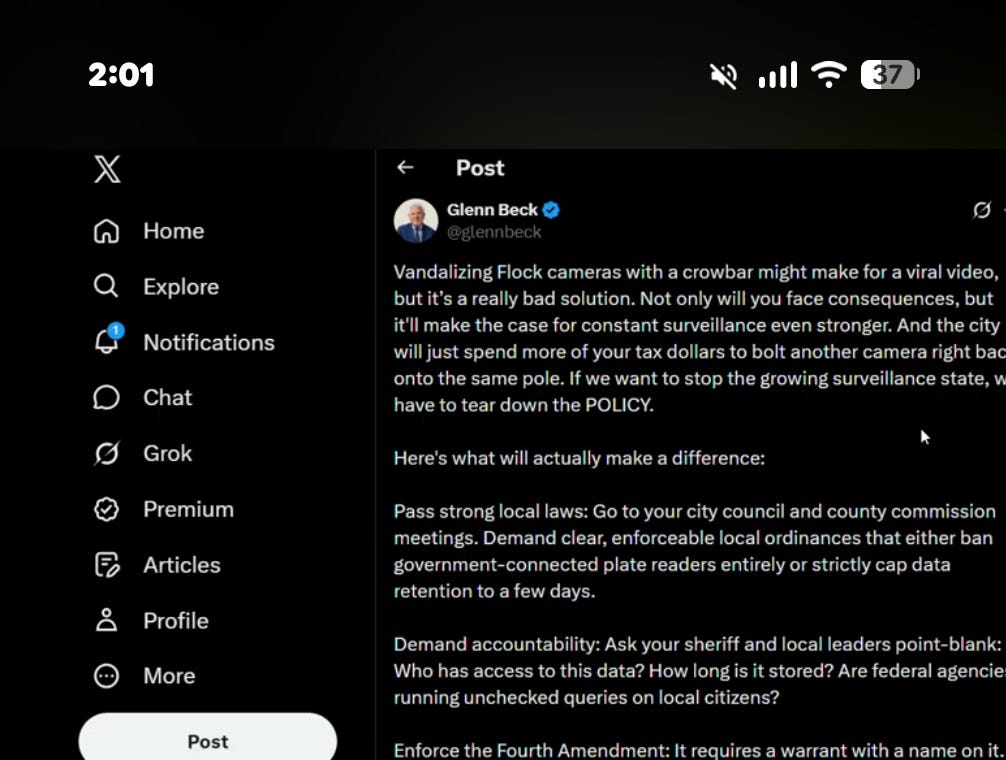
Glenn Beck made a similar point, minus any sympathy for the bolt cutters. Vandalizing a camera “might make for a viral video,” he wrote, but the city will just replace it and use the incident to justify even more surveillance. His argument is that the fix isn’t destruction, it’s policy: local ordinances that ban government-connected plate readers outright or strictly limit how long the data can be kept, real answers from sheriffs about who has access to the database, and enforcement of the warrant requirements the Fourth Amendment already promises.
That’s the version of this fight worth having. Not a felony charge and a bolt cutter, but a packed city council meeting and a city that decides, the way Winona just did, that it isn’t worth it.
Are those cameras really "government property"?
The article states that these were installed by Flock Safety. Usually, the government installs their own property, rather than hiring out that service to the vendor.
Do those various governments actually purchase those cameras? Or are they loaned out by the company? Who is in possession of the searches?
These questions may determine whether we are talking about government property or private property.