
Kaizen Asiedu didn’t need a lecture hall or a syllabus to expose the biggest gap in American civic education today. He needed sixty seconds and a straight face.
This clip runs right around the ten minute mark. Watch the video above at this time.
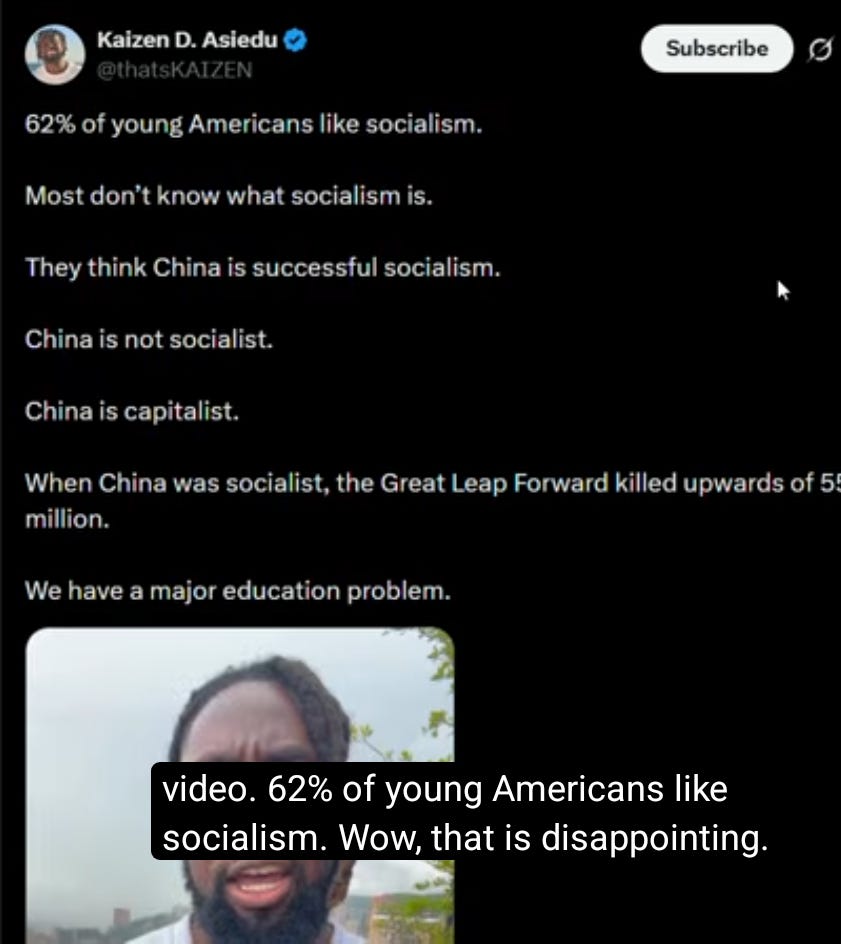
The stat alone should stop you cold. Sixty two percent of young Americans say they like socialism. Asiedu’s first reaction was blunt. “Wow, that is disappointing,” he said, and it should be, until you realize the real problem isn’t the percentage. It’s what’s hiding underneath it.
Because here’s the twist nobody wants to sit with. Most of these young people supporting socialism cannot actually define socialism.
Support the Deskooled Substack. Get 50% off for a year.
They’re not rejecting capitalism after weighing the evidence. They’re picking a label based on vibes, and the model they keep pointing to as proof socialism works is China. Asiedu called this out directly, and dismantled it in one clean move. “China is not a socialist success story. China is actually a great argument against socialism,” he said.
Why does that distinction matter so much?
Because definitions determine decisions, and if an entire generation is voting, protesting, and building political identities around a word they cannot correctly define, that’s not a policy disagreement. That’s an education failure with a national scoreboard attached.
Asiedu laid out the actual definition with a precision most high school civics classes never bother with. Socialism, he explained, “is an economic system defined by one key thing, collective ownership of the means of production.” Farms, factories, companies, all owned and controlled by the state. Capitalism is simply the reverse. Private ownership, private control, private risk. Universal healthcare and affordable housing programs, he pointed out, are not proof of socialism either. Those exist under both systems. Confusing a safety net with an entire economic structure is exactly the kind of shallow thinking a real education is supposed to prevent.
Then came the history most students never get.
China’s government, Asiedu noted, produces around 25 percent of the country’s GDP today. Compare that to Cuba, an actually socialist economy, where the government produces roughly 85 percent. That gap alone should end the debate. But it gets worse for the socialism-is-working crowd once you look backward instead of forward. Before 1978, China was genuinely socialist, with collectivized farms and abolished private ownership under the Great Leap Forward. The result wasn’t prosperity. It was a famine that killed, by some estimates, tens of millions of people.
Sit with that number for a second.
Then in 1978, Deng Xiaoping came to power and did the exact opposite of doubling down on socialism. He legalized private business. He broke up collectivized farms and handed them back to individual families. He handed the means of production back to the people. Asiedu’s conclusion lands like a hammer. “Socialism starved China. Capitalism saved it.” Eight hundred million people climbed out of poverty in two generations, not because the government tightened its grip, but because it loosened it.
So why do so many young Americans still point to China as the poster child for socialism succeeding?
Because nobody ever taught them the actual timeline. Nobody explained that the boom happened after the socialism ended, not during it. That’s not a minor gap in the curriculum. That’s the entire lesson, skipped.
Asiedu didn’t let capitalism off the hook completely either, and that’s what makes the take sharper than the average partisan take-down. He acknowledged real problems, specifically the billions spent on healthcare lobbyists rigging laws in favor of corporations over consumers. But his point stands regardless. Those are fixable flaws inside a working system, not proof the entire system needs replacing with one that has a documented body count in the tens of millions.
China is not socialist. The Nordic countries are not socialist. And no, America does not need socialism to fix what’s actually broken.
The real scandal here isn’t that young people have strong opinions about economic systems. It’s that they’ve been handed those opinions without ever being handed the definitions first. That’s not education. That’s a generation running on borrowed conclusions, and somebody forgot to teach them where those conclusions came from.
Western civ extinction event knocking at the door. Your replacements are here. Open boarders, chicom, jihad, code pink, dept of ed, cair , UN, zionist israel, brennans and his companies,………. The list is huge and has been going on for my lifetime, McCarthy was dead on
Free stuff! That’s all they hear.